When Time Off Makes You More Dysregulated

TL;DR:

If you’ve ever finally slowed down, gone on vacation, or taken a weekend off and found yourself feeling worse instead of better, just know: you’re not broken and you’re not doing rest wrong. Trauma and chronic stress can train the nervous system to stay in activation mode, so when the activation (think ‘fight or flight’) finally gets a chance to ease up, your body can sometimes read the peace as unsafe or even threatening instead of restful. This can show up as anxiety, irritability, sleep problems, guilt for not ‘doing’ something, or feeling kind of flat when you’re supposed to be relaxing and enjoying it. Nervous system regulation is a skill you build and practice, often with support, and trauma therapy can help you learn to actually tolerate and even enjoy rest and downtime instead of white-knuckling your way through it.


What Nobody Tells You About Rest

You cleared the calendar, booked the trip, and with a thick To Be Read stack on deck, thought to yourself: “This is it. Vacation mode. Let’s go!”

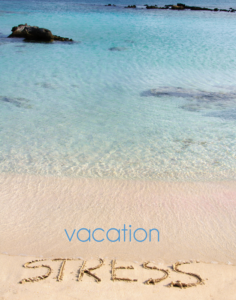
Next thing you know, you’re lying on a beach (or even just lying in your backyard hammock for a staycation, let’s be honest) with nothing scheduled, and… you cannot relax. Your chest gets tight, your mind keeps listing off things you definitely should be doing instead, and dammit if you don’t feel worse than you did at your desk on Wednesday.

If this has happened to you, I want to let you know: it’s not just you, and there’s a reason for it. For a lot of my clients, especially the high-achieving, overthinking, neurodivergent women I work with, slowing down doesn’t feel peaceful. Instead, it feels like a shoe is about to drop right on your head, like you’re definitely about to get into big trouble. Anxiety during vacation is one of the most common (and least talked about) experiences we have in our high-productivity, high-demand capitalist culture, and right along with it, guilt that whispers, “I should be enjoying this.”


Why Time Off Can Feel So Hard

Our human nervous systems developed for millennia under circumstances that many of us in high-income nations don’t deal with anymore. If we’re privileged enough to have consistent and stable housing, food, and community support, we don’t usually have to be on alert for an animal attack at any time. However, when you consider how long humans have been around, that privilege is relatively new, and our systems haven’t quite had time to get the memo and realize that rest doesn’t equal risking death.

Your nervous system really may not know the difference between “busy because I’m thriving” and “busy because I’m trying to make it through the day.” It just knows fight, flight, freeze, fawn. Do something, even if it’s fall out and play possum. If you’ve spent years (or a lifetime) chronically stressed- whether that’s from traumatic relationships and experiences, unrelenting jobs and bosses, an unpredictable household, or a brain that never stops scanning for what will go wrong next- your system has learned that activation is the norm. Stress is the baseline.

Stay with me here, because this is where burnout recovery can start feeling counterintuitive. A nervous system that’s been running on adrenaline for months or years has found hypervigilance as a baseline. Constantly doing, checking, planning, and achieving isn’t just a habit at that point. It’s become a regulation strategy, even if it’s an exhausting one. Your system feels like it’s keeping something potentially dangerous at bay, even if there’s no clue what that ‘danger’ is.

So when you stop Go Mode, your to-do list disappears, and your schedule opens up, that hypervigilance strategy isn’t needed. It may seem like the alternative should just be “calm” but instead, you might notice all the internal shit that Go Mode was managing: grief, old trauma, or a body that’s forgotten what safety is if it’s not driven by effort to prove your value.

This is especially true for people with trauma histories. A nervous system shaped by trauma often equates stillness with danger, because stillness used to mean vulnerability to danger. Stillness might have been how you stayed off the radar of an angry or abusive caretaker. Slowing down can inadvertently open the door to memories, sensations, or emotions that are normally outrun by constantly Doing Something.

Common Signs of Dysregulation During Rest

Dysregulation during downtime doesn’t always look like obvious panic. In my practice, it shows up in ways clients often don’t connect to rest at all:

  • Trouble sleeping the first few nights of a vacation, even when exhausted
  • Snapping at loved ones even though the pressure is off
  • Racing thoughts about work, tasks, or “what’s next” the moment things get quiet
  • A sense of dread or feeling emotionally flat instead of enjoyment on days off
  • Physical symptoms like stomach issues, headaches, tension, restlessness
  • Guilt that’s practically tangible, because rest=lazy, and that’s bad
  • The impulse to fill any silence immediately, whether doing something ‘productive’ or just doomscrolling

If any items in that list feel familiar, you’re not alone, and it doesn’t mean you’re incapable of relaxing! Your nervous system is doing exactly what it learned to do to keep you safe, and that’s good! That’s its job. Your system just needs to learn a different way of being- that sometimes, not-doing + silence actually = chill.

How Therapy Helps

This is where trauma therapy and nervous system regulation work come in, and it’s some of my favorite work to do with clients. The goal isn’t to force yourself to “just relax” – in fact you may have already tried that, and found that it didn’t work!

Instead, your goal is to build actual capacity and even tolerance for rest, in small doses and with support, so your body can learn that safety doesn’t require constant effort. This helps your body experience small moments where “calm” can exist on its own and for its own sake, not just “before the storm.” 

In sessions, this often looks like:

  • Building interoceptive awareness. Learning to notice how early signals of activation show up internally (i.e., tight jaw, shallow breathing, racing thoughts) before they spiral out of control, using approaches like Somatic Experiencing (SE).
  • Processing what you notice when things get still. For many clients, EMDR or SE helps address the underlying negative thoughts or chronic worry that gets louder once the noise of constant-busyness fades.
  • Practicing rest in small doses. Instead of a two-week trip that overwhelms your system with all its downtime, we might start with ten minutes of unstructured time, gradually expanding your window of tolerance for turning off productivity-mode. This lets your nervous system experience calm without danger being attached to it.
  • Redefining what “slowing down” means. Healing often includes untangling beliefs that link rest to worthlessness, laziness, or danger, especially for perfectionists whose value is tied to their productivity.
  • Regulating in real time. Learning tools that support your specific nervous system, not generic advice, so you have ways to support yourself when a slow Saturday starts to feel like a threat.

Over time, clients don’t just tolerate rest better, they start to actually feel it. Vacations stop being something to survive, weekends stop feeling like a countdown to Monday*. That shift takes consistent work, but it’s absolutely possible.

*Side bar: I want to highlight that in US culture, productivity is gold. Maaannny workplaces have continued to increase the demands of their employees, doing things like lumping three other job descriptions under your job description’s “other duties as assigned,” and expecting you to be glad for the opportunity to “prove” yourself without paying you more for taking on five zillion other jobs. It’s important to note that there’s a LARGE degree to which stress and burnout from a workplace, especially one that’s unsupportive and puts unreasonable expectations on its employees, is a normal human response to unreasonable demands- not a you-problem. You are not broken if you’re overwhelmed by absorbing the work of three other departments during a re-org. Part of our work together might include helping you find a different work environment!

If Rest Feels Harder than it Should

If slowing down consistently leaves you feeling anxious, irritable, or disconnected instead of rested, that’s worth noticing instead of just pushing through it (or jumping right back into Doing Something Productive). It’s not a personal failure or a sign that you ‘can’t’ rest. It’s more likely that your nervous system adapted to survive by constantly doing, and you deserve to learn new ways of letting yourself and your nervous system exist.

If this sounds familiar, I’d love to help you practice a different relationship with rest. Reach out to schedule a consultation, and let’s talk about what’s keeping your system on high alert, and what we can do to help it.


About Holly

Holly Scott, LPE-I, LPC, SEP is a licensed therapist with over 15 years of experience supporting clients in and around Little Rock, Arkansas. She specializes in helping anxious neurodivergent millennials walking the line of ADHD/AuDHD, anxiety, and mild OCD, often with a dash of childhood trauma thrown in. She uses evidence-based approaches like EMDR and hypnosis to help clients slow their overthinking/shame spirals and start enjoying life. As the solo therapist at Therapy with Holly, Holly is committed to providing compassionate, expert care both in-person and online for clients across Arkansas.